Income Tax for Freelancers in India: TDS, 44ADA and Advance Tax
As a freelancer, nobody deducts all your tax for you. Some clients deduct TDS, some don't, and the rest is your job. Here is how it works.
Your income is "business or profession" income
Freelance fees are taxed as income from business or profession, at the same slab rates as salary. You can choose the new or old regime when filing.
Option 1: Presumptive taxation (popularly Section 44ADA)
If you are in a listed profession (design, IT, consulting, writing and similar technical or professional work generally qualify), you can declare 50% of gross receipts as profit. You don't need detailed books, and you can't claim expenses separately. It applies up to ₹75 lakh of receipts when cash receipts are 5% or less.
Option 2: Normal books
Profit = receipts − actual business expenses (software, internet, equipment depreciation, co-working, travel, professional fees). This is better only if your real expenses are above 50% of receipts, which is rare for most freelancers.
TDS: tax already paid on your behalf
Indian business clients usually deduct 10% TDS on professional fees and pay it to the government in your PAN. You see it in Form 26AS and AIS. It counts against your final tax. Overseas clients and individuals usually don't deduct TDS.
Advance tax
If your tax after TDS is ₹10,000 or more, pay advance tax during the year:
- Normal books: 15% by 15 June, 45% by 15 September, 75% by 15 December, 100% by 15 March
- Presumptive scheme: the full amount by 15 March
Late payment means interest of 1% a month on the shortfall.
A worked example (FY 2026-27, new regime)
- Receipts: ₹5.87 lakh from Indian clients (TDS 10%) and ₹2.7 lakh from overseas clients
- Gross receipts ₹8.57 lakh → presumptive profit ₹4.29 lakh, plus ₹18,000 interest
- Total income about ₹4.5 lakh: under ₹12 lakh, so tax is zero after the rebate
- TDS of about ₹58,700 already deducted → you claim it back as a refund in your return
Doubling receipts changes the picture fast, so check your estimate every quarter.
Simple habits that save trouble
1. Log every invoice and payment the day it happens.
2. Download Form 26AS/AIS every quarter and match TDS with your log.
3. Keep a separate bank account for freelance income.
4. Set aside 15 to 25% of overseas income for tax.
Our Freelancer Income & Tax Tracker logs invoices, TDS and expenses, compares presumptive and normal tax, and shows advance tax due on each date. Confirm your final return with a chartered accountant.
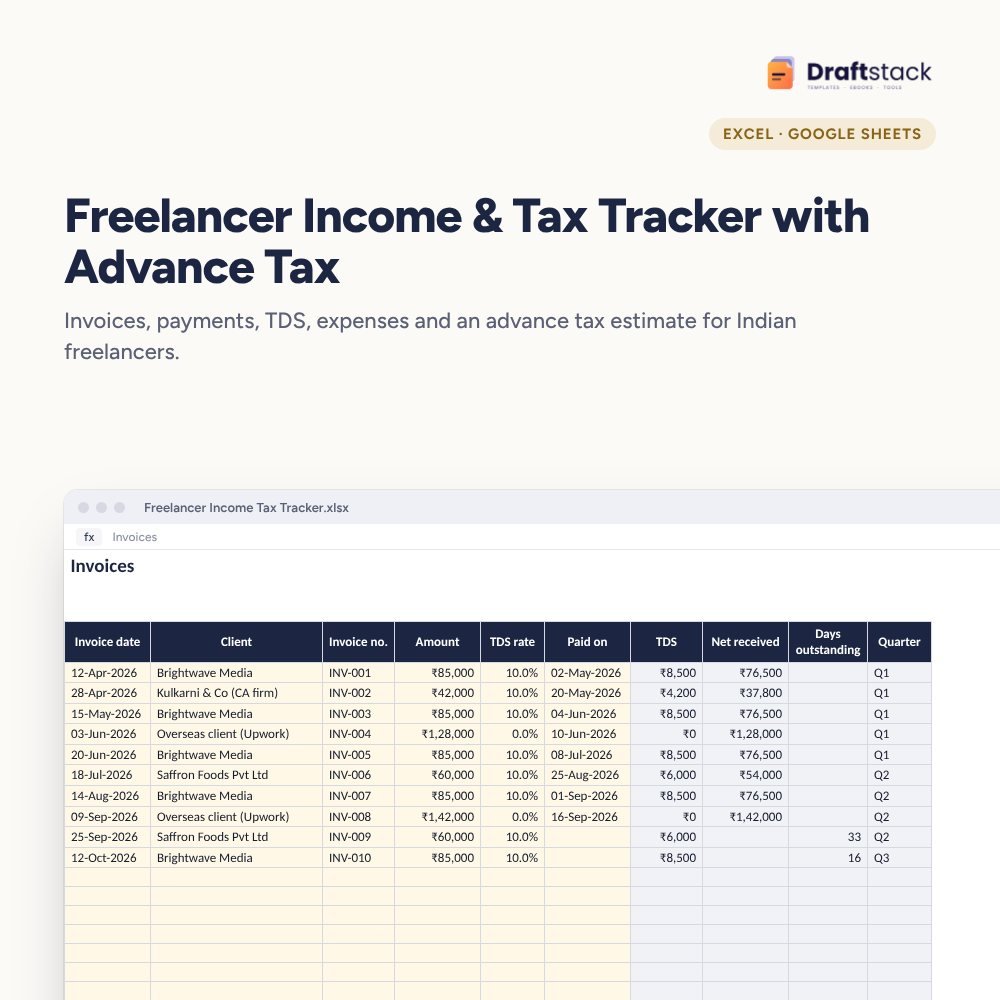 The template from this guideFreelancer Income & Tax Tracker with Advance Tax (Excel)
₹149
 WhatsApp
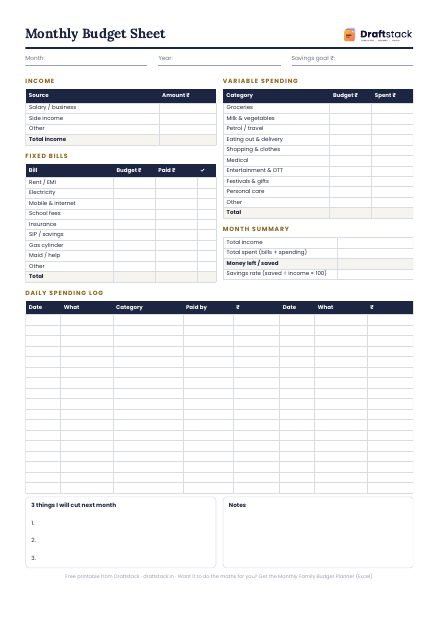
Free Monthly Budget Sheet
A printable one-page budget sheet: income, fixed bills, daily spending and savings for the month. Print it or fill it on your phone.
More guides
CTC to In-hand Salary: How to Calculate Your Take-home Pay
Every line between CTC and the amount in your bank: employer PF, gratuity, variable pay, employee PF, professional tax and income tax, with a worked FY 2026-27 example.
How Much Emergency Fund Do I Need? (Indian Families)
How to calculate your emergency fund from essential costs, how many months to keep for your situation, where to park it and how to build it.
NPS Pension Calculation: How Much Will You Get at 60?
How the NPS corpus builds up, how the lump sum and annuity split works, a worked example, and what changes the final pension the most.