How to Run a Fair Annual Performance Appraisal
Employees rarely object to a low rating that's explained well. They object to surprises, unclear rules and managers who score differently. A fair appraisal is mostly about clarity.
Step 1: Agree KRAs at the start of the year
Each person should have 3 to 6 Key Result Areas, each with:
- A weight (all weights add to 100%)
- A measure (sales vs target, rejection rate, on-time delivery)
- What 3 out of 5 means (met the target) and what 5 means (well above)
Write these down and share them in April, not in March.
Step 2: Add competencies
Results aren't everything. Competencies like teamwork, ownership, customer focus and communication matter too. A common split is 70% KRAs and 30% competencies.
Step 3: Score consistently
Use a 1 to 5 scale everywhere:
- 5 far above expectations
- 4 above expectations
- 3 met expectations
- 2 partly met
- 1 did not meet
Final score = KRA score × 70% + competency rating × 30%.
Step 4: Bands and increments
Map final scores to bands, and bands to increments. For example:
- Outstanding (4.5+): 15%
- Exceeds (3.75 to 4.49): 10%
- Meets (2.75 to 3.74): 7%
- Partly meets (2 to 2.74): 3%
- Below (under 2): no increment, with an improvement plan
Step 5: Calibrate before announcing
Look at the distribution. If one manager rated everyone 'Outstanding', or 60% of the company sits in the top band, scores probably drifted. Hold a calibration meeting where managers explain their top and bottom ratings. The expected curve is a check, not a quota.
Step 6: Check the cost
Add up the new salary bill and the average increment. If it's above budget, adjust the increment table, not individual ratings.
The appraisal conversation
1. Start with what went well, with examples.
2. Go through each KRA score and the evidence.
3. Agree on one or two development areas.
4. Set next year's KRAs in the same meeting.
Handling disagreement
If an employee disagrees with a rating, listen first and look at the evidence together. If they show results you missed, change the score. If not, explain the gap clearly and agree what a higher rating would need next year. A short written note of the discussion protects both sides.
Our Performance Appraisal Forms & Rating Calculator works out weighted scores, bands, increments and new CTC, and shows the distribution against your expected curve before you finalise.
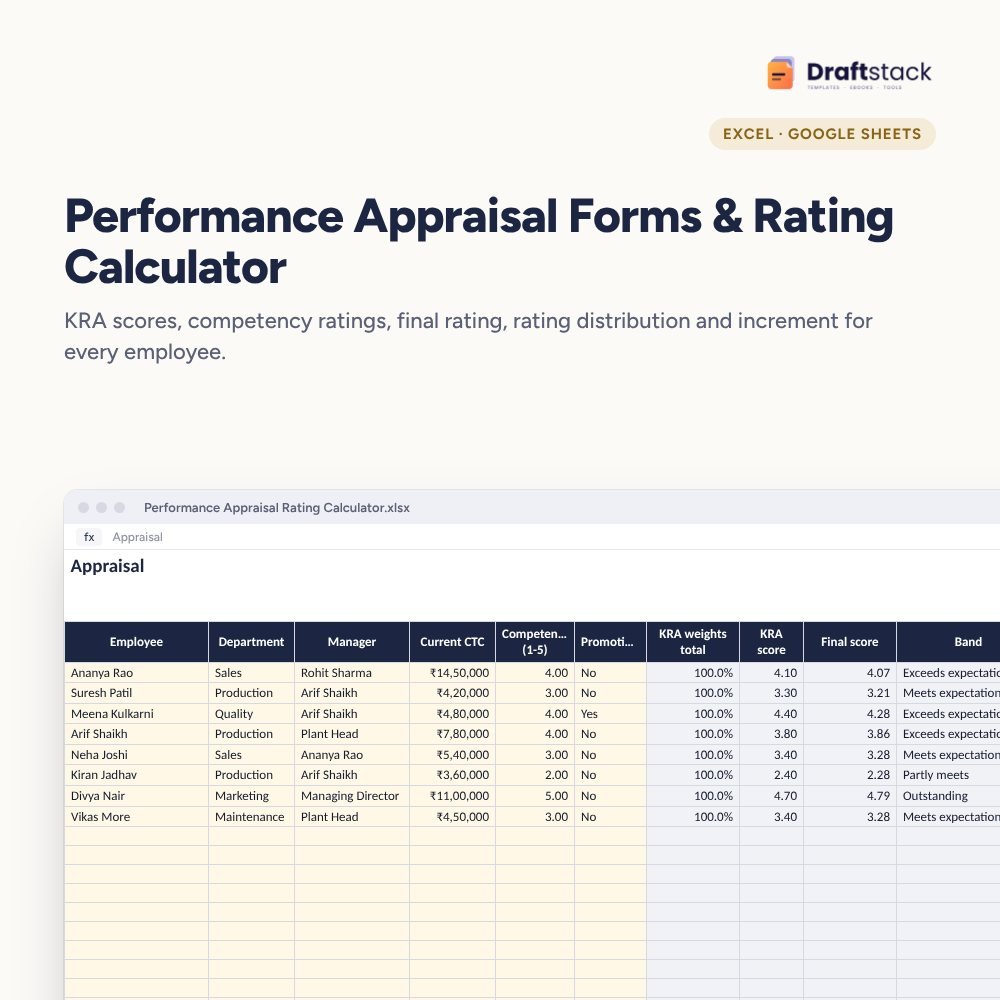 The template from this guidePerformance Appraisal Forms & Rating Calculator (Excel)
₹349
 WhatsApp
Free Monthly Budget Sheet
A printable one-page budget sheet: income, fixed bills, daily spending and savings for the month. Print it or fill it on your phone.
More guides
How to Write Good OKRs for Your Team (with Examples)
Objectives vs key results, measurable key results, targets that go up or down, weekly check-ins, scoring, and examples for every team.
What to Keep in Your Employee Master File (and What Not To)
The fields every employee record needs, what's risky to store, probation and gratuity dates, and simple HR numbers like attrition and tenure.
Monthly Statutory Compliance Calendar for Indian Companies
The dates every Indian company must track: TDS, GST, PF, ESI, professional tax, advance tax, ROC filings, bonus and POSH, with a simple monthly routine.