How to Plan for Your Child's Higher Education Cost
Higher education is the biggest planned expense for most Indian families after a home. The earlier you put a number on it, the smaller the monthly saving needs to be.
Step 1: Estimate today's cost
Add up fees, hostel, food, books, travel and living costs for the whole course. Rough current examples:
- Private engineering (4 years): ₹12 to 20 lakh
- Private MBBS (5.5 years): ₹60 lakh to over ₹1 crore
- MBA at a top private institute: ₹20 to 30 lakh
- Master's abroad including living costs: ₹35 to 60 lakh
Step 2: Add education inflation
Education costs have been rising faster than general prices. Using 9% a year:
- ₹16 lakh today becomes about ₹45 lakh in 12 years
- ₹25 lakh today becomes about ₹70 lakh in 12 years
Formula: future cost = today's cost × (1 + inflation) ^ years.
Step 3: Count what you already have
If you've saved ₹1.5 lakh and it grows at 11% for 12 years, it becomes about ₹5.2 lakh. Subtract that from the future cost to find the gap.
Step 4: Work out the SIP
For a gap of about ₹40 lakh in 12 years at 11% a year, a flat SIP of roughly ₹14,000 a month is needed. A SIP that rises 10% every year can start near ₹9,000 and grow with your income.
Step 5: Choose where to invest
- More than 7 years away: mostly equity mutual funds, plus safe options like PPF or Sukanya Samriddhi for a part
- 3 to 7 years away: a mix of equity and debt
- Last 2 to 3 years: move gradually into debt funds or FDs, so a market fall right before admission doesn't hurt
Common mistakes
1. Using today's fees as the target.
2. Starting when the child is in Class 9 or 10. The SIP then needs to be three or four times bigger.
3. Keeping the goal money in a savings account.
4. Using goal money for other spends. Keep it in a separate folio or account.
Review once a year
Check the plan on your child's birthday. Raise the SIP with your salary, update the course cost if your child's interests change, and start shifting to safer options in the last few years.
Use safe options for part of the goal
PPF, Sukanya Samriddhi (for daughters) and recurring deposits are useful for the part of the goal you don't want exposed to the market. Many families split the monthly saving: two-thirds in equity funds while the goal is far away and one-third in safe options, then shift more to safe options as admission gets closer.
Our Child Education Goal Planner works out the future cost, the flat and rising SIP needed, and a year-by-year path, for any course you choose.
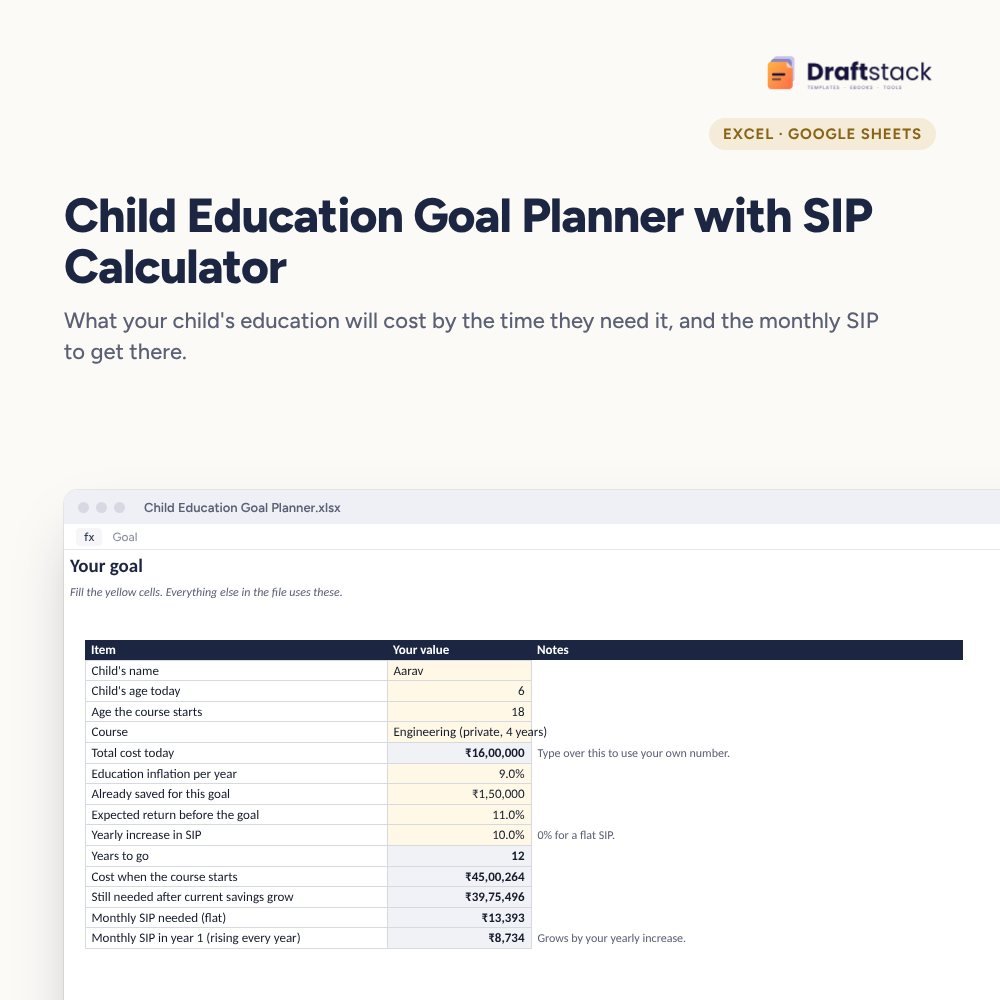 The template from this guideChild Education Goal Planner with SIP Calculator (Excel)
₹149
 WhatsApp
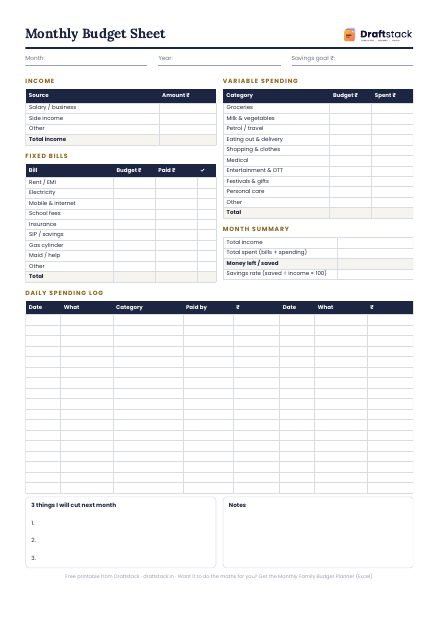
Free Monthly Budget Sheet
A printable one-page budget sheet: income, fixed bills, daily spending and savings for the month. Print it or fill it on your phone.
More guides
How to Split Rent and Bills with Roommates (Fairly)
Fair ways to split rent by room, shared bills, groceries and the cook's salary, how to settle up each month and the house rules that keep flats friendly.
How to Compare Personal Loan Offers (Look at APR, Not the Rate)
Interest rate vs APR, how fees and insurance change the cost, a worked example with four offers, and red flags to avoid.
Car Loan or Cash: Which Is Better for You?
How to compare a car loan with paying cash, why the flat rate trick matters, a worked example, and the questions to ask the dealer.