FD Maturity Amount and TDS on FD Interest, Explained
Fixed deposits are simple to open and easy to lose track of. Here is how the numbers work, so you can check your bank and plan renewals and tax.
How FD maturity value is calculated
Most Indian banks compound FD interest every quarter. For a cumulative FD:
Maturity value = Principal × (1 + rate ÷ 4) ^ (number of quarters)
Example: ₹2,00,000 at 7.05% for 24 months (8 quarters) = 2,00,000 × (1.017625)^8 ≈ ₹2,30,040. Interest earned is about ₹30,040.
With a monthly or quarterly payout FD, interest is paid out as it is earned and the maturity value is just the principal.
How RD maturity value is calculated
For a recurring deposit with monthly instalment R, quarterly rate i (annual rate ÷ 400 when the rate is in percent) and n quarters, banks use:
Maturity = R × [(1 + i)^n − 1] ÷ [1 − (1 + i)^(−1/3)]
A ₹5,000 RD at 6.65% for 24 months gives roughly ₹1,28,000, of which ₹1,20,000 is your own money.
When TDS is cut on interest
Banks deduct 10% TDS (20% if PAN is not linked) when interest from that bank crosses ₹50,000 in a financial year, or ₹1,00,000 for senior citizens. The limit is per bank, not per FD, and it counts interest earned, not only interest paid out.
Form 15G and 15H
If your total income is below the taxable limit, you can submit Form 15G (below 60) or Form 15H (60 and above) to the bank at the start of each financial year, and it will not deduct TDS. Submit it to every bank where you hold FDs.
TDS is not the final tax
FD interest is taxable at your slab rate every year, even for a cumulative FD that pays at maturity. If you are in a higher slab, you may owe more than the TDS. If you owe less, you claim the extra back in your return.
Never miss a renewal
1. Keep one list of every FD and RD with its maturity date.
2. Check it on the 1st of each month and look 30 days ahead.
3. Before renewing, compare rates; small finance banks and the Post Office sometimes pay more.
4. Keep deposits in a single bank under ₹5 lakh per depositor if you want them fully covered by DICGC insurance.
Quick checklist for every FD
1. Note the receipt number, holder, nominee and maturity date the day you open it.
2. Choose cumulative if you don't need regular income; payout FDs suit retired parents.
3. Check whether it auto-renews, and at what rate.
4. Spread large amounts across banks to stay within insurance cover.
5. Keep Form 15G or 15H copies and match TDS with Form 26AS every year.
Our FD & RD Maturity Tracker works out maturity values the way banks do, warns you 30 days before each maturity and adds up interest per bank so you can see where TDS will apply.
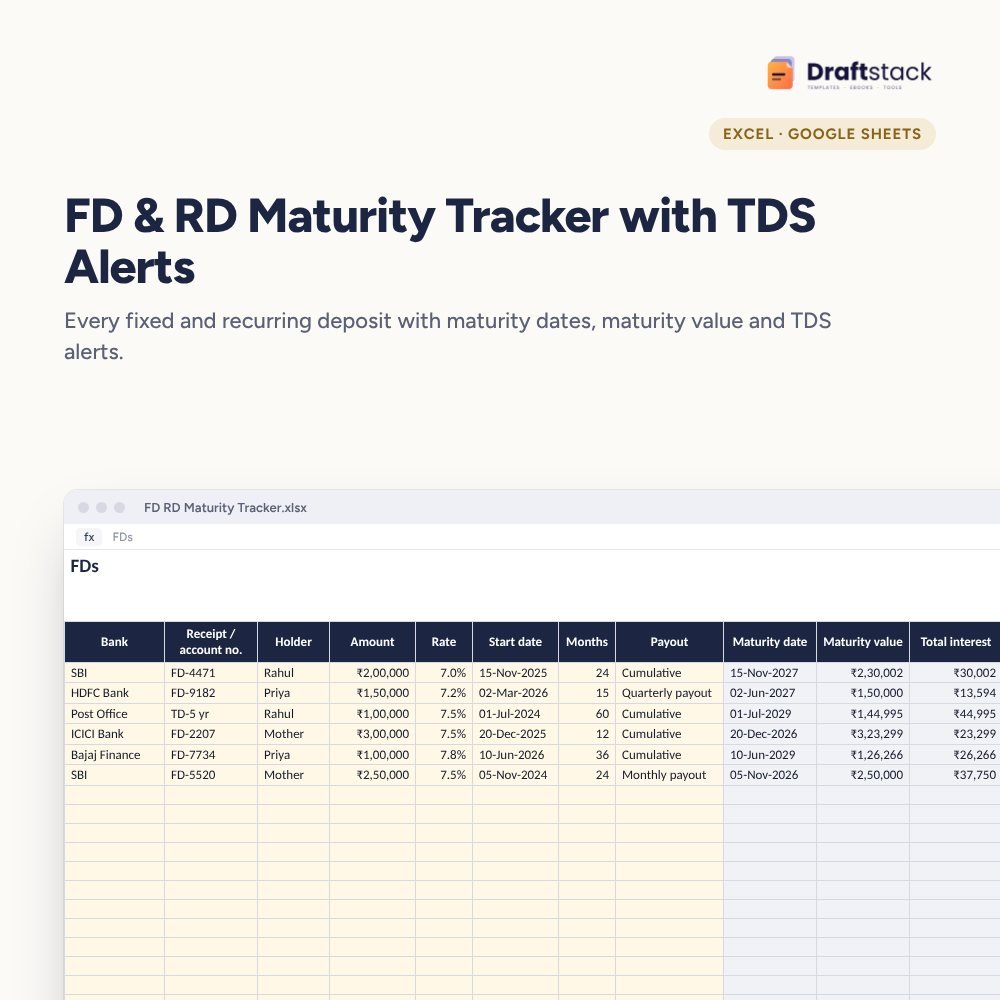 The template from this guideFD & RD Maturity Tracker with TDS Alerts (Excel)
₹149
 WhatsApp
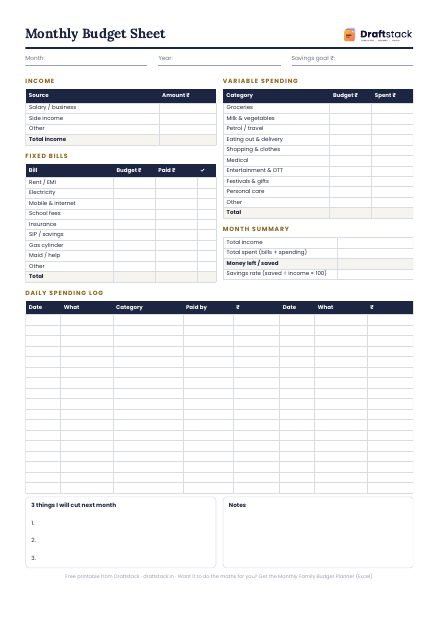
Free Monthly Budget Sheet
A printable one-page budget sheet: income, fixed bills, daily spending and savings for the month. Print it or fill it on your phone.
More guides
What Is XIRR in Mutual Funds (and How to Calculate It in Excel)
Why absolute return misleads for SIPs, how XIRR works, a worked example, and how to calculate it yourself in Excel or Google Sheets.
How to Keep a Record of Your Family's Gold Jewellery
What to note for each piece, how to value 22K and 18K gold from today's rate, why HUID and bills matter, and how jewellery schemes really work.
How to Never Miss a Credit Card Due Date (and Avoid Interest)
Statement date vs due date, why minimum due is a trap, how credit use affects your score, and a simple monthly routine for two or more cards.